Dermatologists Say Most Men Lose Their Hair for One Simple Reason (and It Isn't Just Genetics)
Dr. Marcus Hale spent 25 years treating patients with hair loss. Then he started losing his own. Here's what he learned, and the simple drug-free solution he now uses himself. It takes him only ten minutes a day.
 By Dr. Marcus Hale, board-certified dermatologist ·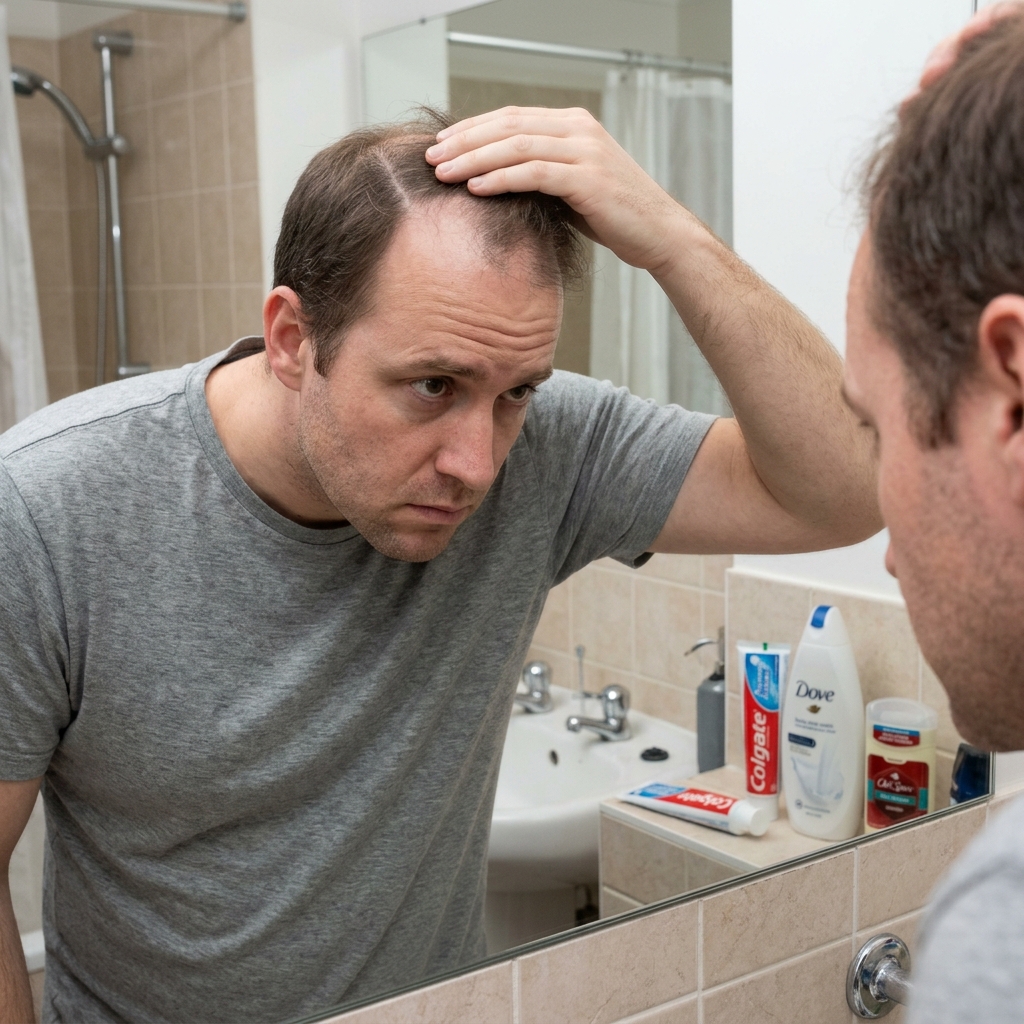
It usually starts in the mirror. One morning you catch a glimpse of the top of your head, and your stomach drops. When did it get so thin up there?
Or someone just says it out loud. Your barber, your friend, the woman you love. "Your hairline's really going back, man." You laugh it off. But you don't forget it. Because you can't...
So you start checking how bad it is. You look in the bathroom mirror, then in the car, then in your phone camera held up high so you can see the top of your head. You do it ten times a day, praying it's not as bad as you think. But unfortunately it is, and every month it only gets worse. There's more scalp showing where your hair used to be, and less of it left to cover the rest of the head.
Why doing nothing is the worst thing you can do for your hair
This is the part that hurts the most. You still have your hair, but you're losing more of it every week, right in front of you. You see it in the shower drain after you wash it. You see it on your pillow in the morning. The thin spots on top keep spreading wider, and your hairline keeps backing up, month after month.
Nothing you do makes it stop, and it starts to run your whole day. You wear a hat almost everywhere now, indoors and outdoors, because it hides the thin spots on top. You comb what's left of your hair over to one side, covering the bare patches so they don't show. You dread the wind, because one gust blows it all out of place and uncovers everything you were hiding. You dread walking into a room with bright lights on the ceiling, because that light shines straight down through your thin hair and lights up your scalp for the whole room to see.
Then you skip the group photo at a party, or slide to the back row where no one can see the top of your head. And under all of it sits a worry that never shuts off. A low, constant knot in your gut about how old and tired it makes you look. People stop giving you that second glance. You walk into a room and feel like no one really notices you're there. That's what losing your hair does to you. It makes you feel like you're disappearing.
Here's the part nobody warns you about. Every month you wait, more of your follicles die off forever. A follicle that dies never grows another hair, no matter how long you wait. Once it's gone, no pill, no cream, and no surgeon on earth can bring it back.
I treated this for 25 years. Then it happened to me
In my mid-40s, it was my turn. After years of treating hair loss in other men, my own hair started to go. It thinned at the top of my head first. Then the hair at my temples, and the front corners above my forehead, started to pull back too.

I caught myself doing the same things I'd watched my patients do for years. I tilted my head a certain way in photos, and I grabbed a hat on my way out the door to cover my receding hairline without even thinking about it.
I'd treated hair loss my whole career, and it still scared me. So I'm going to tell you the truth I tell my patients. There's one secret the whole hair-loss industry works to keep quiet, because if every balding man knew it, they'd lose a fortune.
First, let me save you the years I wasted on the "big three solutions"
Most men try one of three popular solutions. My hair loss was so bad that I tried all of them. Here's the honest truth about each one.
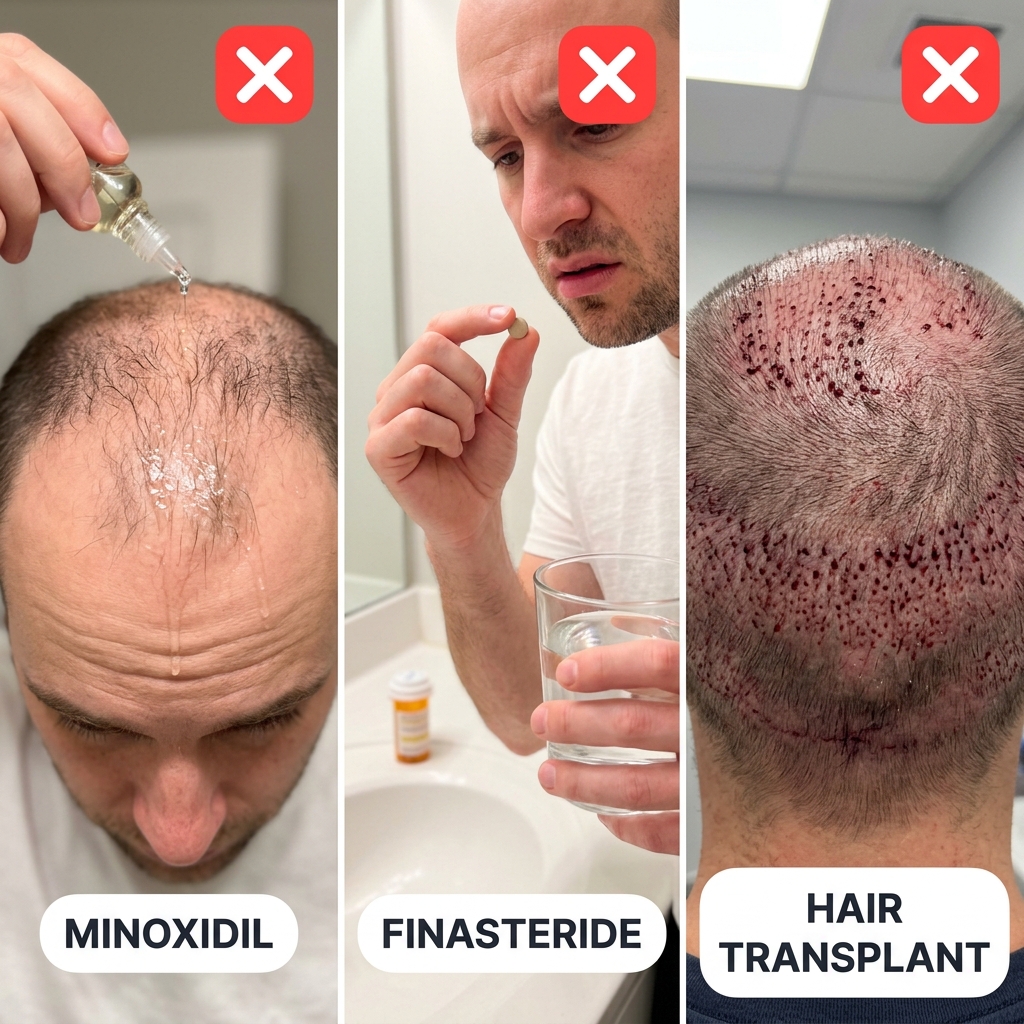
Minoxidil, the daily liquid. Most men try this one first. It actually started out as a blood pressure drug, until doctors noticed it grew hair as a side effect. So they bottled it up and sold it as a hair-loss solution. You rub it into your scalp twice a day, every day, for the rest of your life. And here's the catch. The day you stop, you lose every hair it gave you. When you first start, most men shed even more hair before anything gets better, if it ever does. It's greasy, drips down your forehead, and soaks into your pillow at night. For a lot of men, after years of minoxidil treatment, it barely does anything at all.
Finasteride, the pill. This one's a pill you swallow every day. It works by blocking a hormone in your body. The trouble is, that hormone does a lot more than feed your hair. It's also a big part of your sex drive and how you perform in the bedroom. So when you block it, a lot of men lose their drive completely, or they can't get an erection at all. For some men, those problems stick around for years, even after they quit the pill. That's why it scares so many men off. And it's one more pill you swallow every single day, for the rest of your life.
The hair transplant. This one's surgery. A surgeon cuts hair out of the back of your head, one tiny piece at a time, and moves it up to your bald spots. It takes hours in a chair, and you walk out with a head full of scabs that take weeks to heal. And the cost isn't a few hundred dollars. It runs into the tens of thousands, as much as a new car. Here's the part the clinics never tell you. Even after you spend all that money and go through all that pain, you still have to take the drugs every single day. And if you stop taking them, the rest of your hair keeps falling out anyway.
So most men do nothing, and I understand why. But doing nothing is the one choice that promises you go bald.
Here's what's really happening on your head
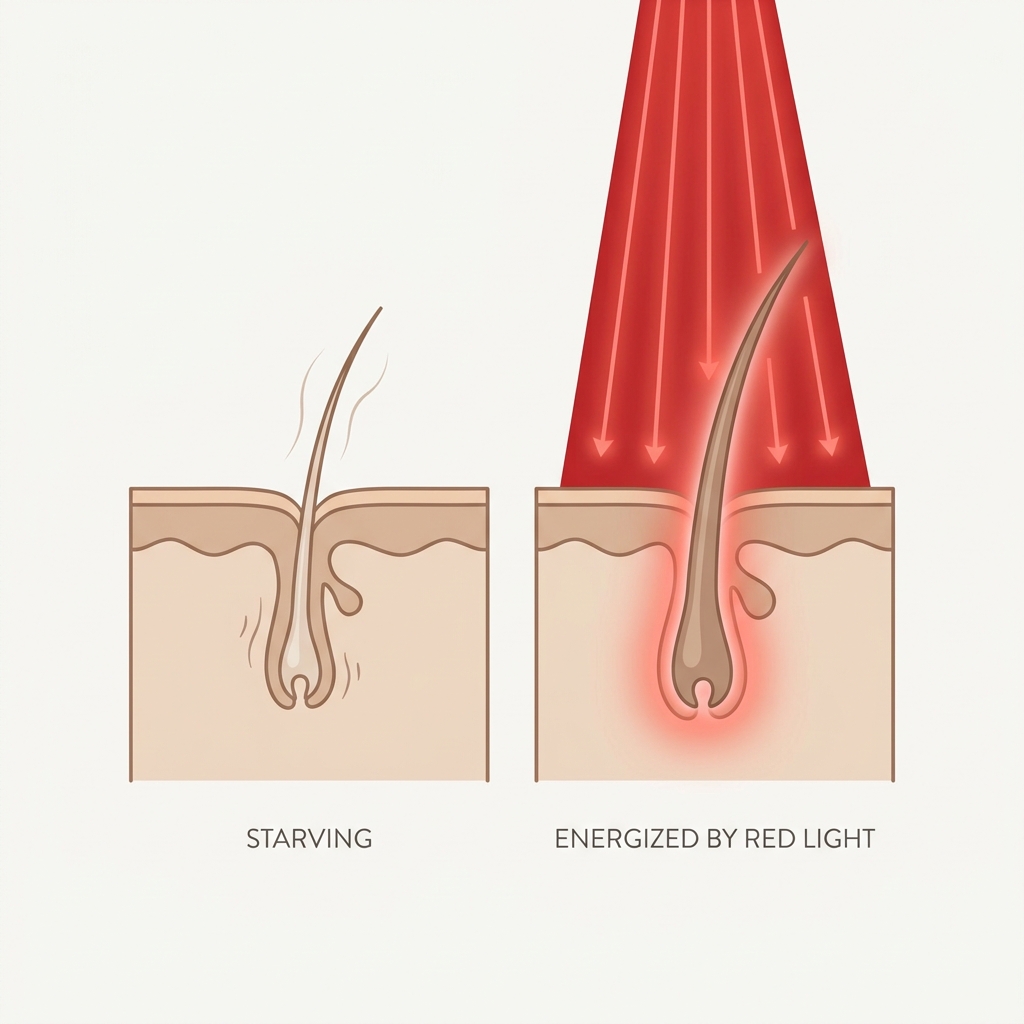
Your follicles aren't gone. They're starving.
A hormone called DHT slowly chokes each one. It cuts down the blood flow. So the follicle runs low on the one thing it needs to grow a thick, strong hair. That one thing is energy. With less energy, the follicle shrinks. Each new hair comes in thinner and weaker than the one before, until one day it stops coming at all.
Now look at those three treatments one more time. Minoxidil pushes a little more blood. Finasteride blocks the hormone. A transplant just moves hair from the back of your head to the front. But not one of them puts the energy back. And that missing energy is the whole problem. It's why so many men try everything and still watch their hair go. They're all treating the wrong thing. The real fix is to put the lost energy back. And that's the one thing I finally found a way to do.
So I went back to the one thing that helped my patients
It was a specific, gentle kind of red light, aimed right at the scalp. Doctors have used it on hair for years. And I need you to hear why this isn't a gimmick.
This red light has been FDA-cleared for men since 2007. Let me explain exactly what that means, because this is where most companies try to fool you. The FDA is the government agency that decides what is safe to sell to patients like you. Before a red-light device like this one can be sold for hair loss, the FDA has to review it and confirm it's safe to use. That's what "cleared" means. They looked at it, and they signed off on it as safe.
And here's the big one. The American Academy of Dermatology looked at the studies. They found this red light worked as well as minoxidil for hair loss.1 Read that again. The same result the drug gives you, but you never put a single drug into your body. No pill to swallow. No chemicals soaking into your scalp. No hormones messing with the rest of you. Just red light.
There are no pills, no hormones, and no shedding. I'd followed this research for years. The only problem was the price. The real clinic machines cost hundreds of thousands of dollars, and you had to keep driving back for more treatment.
Then I had an idea. What if you could just wear it?
From the outside, it's a plain black hat. The kind you'd throw on to grab coffee. But hidden inside the lining is a ring of small red lights. Nobody can see them. Nobody knows it's doing anything at all.
And that's the part I love most. You've spent years hiding under a hat, and now the hat is the thing that helps you. You put it on for ten minutes while you check your email or watch a game. There's no dropper to squeeze onto your scalp. No pill to swallow. No grease, no drip, nothing soaking into your pillow at night. And because it looks like any plain black hat, nobody around you has the faintest idea it's doing anything. Not your coworkers, not your friends, not even the woman you love sitting right next to you. To the rest of the world, you're just a guy wearing a hat.
I call it Hairlume.

Here's the proof, and you can check every piece of it yourself
It's an FDA-cleared device, and it uses the very same red light that was tested in the published research.1 And these weren't flimsy little surveys. These were real clinical trials, the kind doctors trust, where men used this exact kind of light for months while researchers measured the actual change in their hair. That's the same body of research the American Academy of Dermatology looked at when they said the red light works as well as minoxidil. Now for the honest part. This takes time. Most of those trials ran four to six months before the results showed up. So anyone who promises you overnight is lying to your face.*

What it looks like when it turns around
Look at the hair before the red light therapy. Then look at the change after months of using the hat. This is the kind of progress men see.
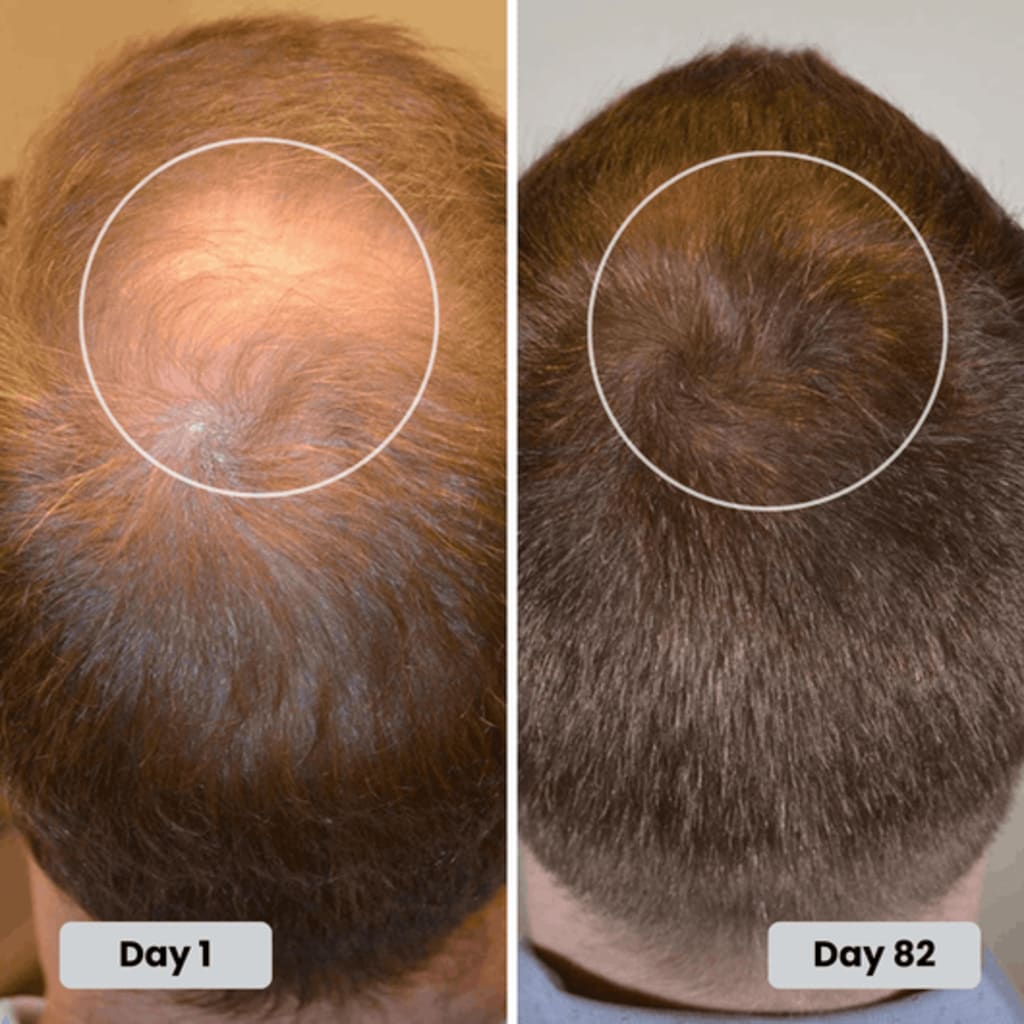
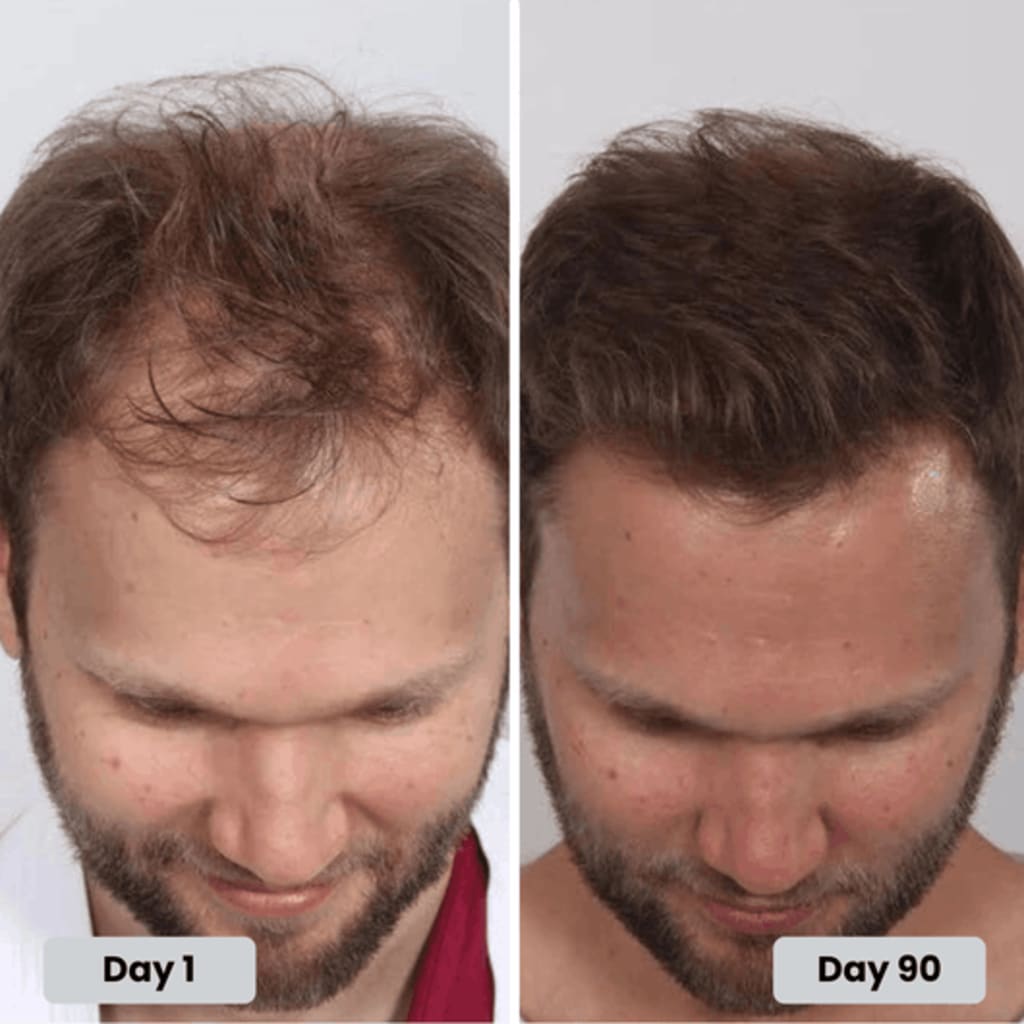
Individual results vary. Most studies run 4 to 6 months.
Get Special Hairlume Hat Offer90-Day Money-Back Guarantee · Free Shipping"But doesn't it only work if I use minoxidil too?"
This is the big one. It's the question every skeptic throws at it, and for a lot of men it's the reason they never even try. They heard somewhere that a laser cap does nothing on its own, that you have to pile minoxidil and pills on top or you're wasting your money. So let me answer it straight, as the doctor who actually read the research.
It's not true. In the trials, the red light was tested all by itself, with no minoxidil and no pills, and it still held its own against the drug. And here's why that makes sense. Think back to the real problem, because every other treatment misses it. None of them put the energy back into your starving follicles. The red light does that one job, on its own. That's exactly why it works without a single drug.
Now, could you stack other treatments on top of it? Sure. Some men do, and that's their call. But you don't have to. You don't need a pill that kills your sex drive, or a greasy liquid you rub on forever, just to make the light do its job. That's the whole point of going drug-free. If you've been waiting for one good reason to walk away from the drugs and still fight for your hair, this is it.
Is it safe?
It's drug-free and FDA-cleared. Nothing goes into your body. The red light is the same gentle kind used in clinics. And you're covered by a 90-day money-back guarantee. More on that in a second.
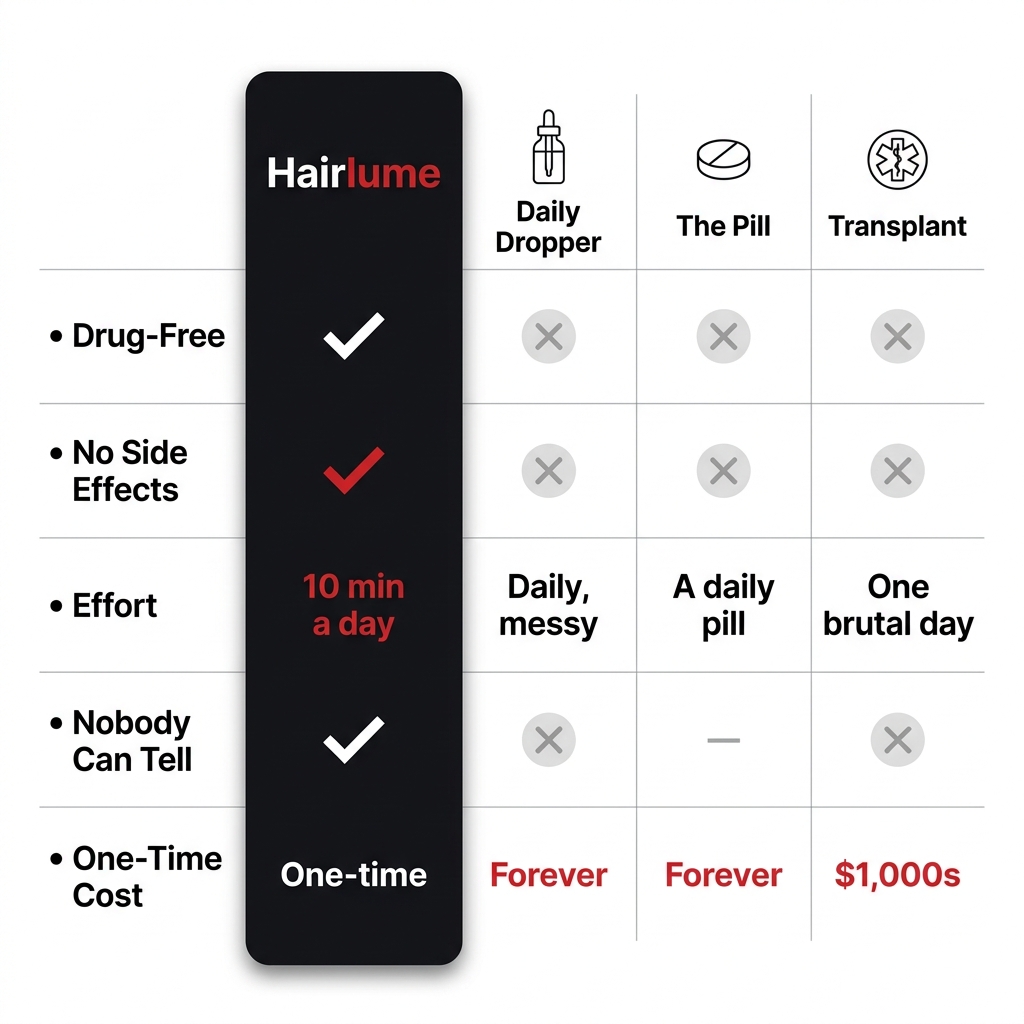
Hairlume vs. Everything You've Tried
 Get Special Hairlume Hat Offer90-Day Money-Back Guarantee · Free Shipping
It's not too late to save your hair — but the window is closing
I won't give you a fake countdown. The real clock is the one on your own head. The light only works on follicles that are still alive, and you lose more of them every month you wait. The best head of hair you'll ever have again is the one you have right now. Protect it while you still can.
Picture six months from now
You run your hand through your hair, and you don't go hunting for a mirror. Someone takes a picture, and you don't care where you're standing. The hat still goes on every morning, but not to hide anything. Now you wear it out of habit, the same way you brush your teeth.

That's the whole reason to start today instead of "someday."
Where to get it?
You can only buy the Hairlume Red Light Hat from the Hairlume website. If you want one, you have to hurry. It sells out fast, and keeping it in stock has been hard. Ordering takes two minutes, so get it before the sale ends.
Try Hairlume risk free
To get your hair and confidence back, all you need to do is wear the Hairlume Red Light Hat ten minutes a day for 90 days. I'm so confident it can help that you have nothing to lose by trying it. The results take months, so we give you a 90-day money-back guarantee to make your hair therapy risk free. The only way to lose from here is to keep doing nothing and watch it fall out.
Get Special Hairlume Hat Offer90-Day Money-Back Guarantee · Free Shipping— Dr. Marcus Hale